.svg)
The Autonomy Triad: Now is the Time for Autonomous Ground Vehicles


The Autonomy Triad: Now is the Time for Autonomou Ground Vehicles
Pat Acox - VP, Defense at Forterra
The ongoing war in Ukraine that began with Russia’s invasion in 2022 has very much been a drone war, with swarms of inexpensive drones filling the skies and holding key military targets under threat on both sides. This conflict has forced the United States military and its industry partners to reflect on their ability to design, develop, test, and field autonomous systems at scale that make a sizable difference on the battlefield.
While some analysts may claim that the U.S. has ignored or underinvested in autonomous systems, the record tells a different story – the U.S. Department of Defense (DoD) has invested heavily in autonomous systems that operate in the air and underwater. Unfortunately, they have not focused or invested as heavily on autonomous ground vehicles (AGVs).
This was substantiated by a recent study by the National Defense University on robotics and autonomous systems, which found that, “The U.S. traditionally underfunds unmanned ground vehicles (UGVs) relative to other uncrewed platforms. In FY 2021, the DoD spent $2.8B on unmanned aerial systems (UAS) while only allocating $241M to UGVs.”
With drones taking on a larger, more impactful role in modern warfare, the principal concern isn’t that DoD underfunds this technology, but that our adversaries don’t share that same hesitation.
The lack of focus on ground autonomy
Recent analyses reveal declines in the U.S. defense industrial base’s attention to ground autonomy. A 2025 report by the Special Competitive Studies Project found that references to autonomy and robotics in strategic guidance documents have dropped by 40 percent - the second largest decrease of any technology area, and most of the remaining discussion centers on aerial and maritime systems.
Major future warfighting concepts devote extensive focus on uncrewed aircraft and naval platforms while virtually ignoring uncrewed ground systems. For example, the Joint Warfighting Concept 2034–2044 paper highlights the need for, “…unmanned…surface and subsurface vessels…,” and emphasizes cheap drones striking airfields, yet it contains no comparable vision for land robotics. Likewise, other forward-looking studies, like CNAS’s Indo-Pacific analysis, tend to fixate on uncrewed air and maritime platforms, barely mentioning UGVs beyond passing mention.
This underscores that ground autonomy has become an afterthought, outshone by its shinier aerial and undersea counterparts. This unfortunate truth is further validated by the painfully slow adoption of AGVs across the DoD despite more than a decade of experiments, war games, and conference slogans about, “Teaming soldiers with robots.”
Programs that have shown promise have been repeatedly scuttled before they matured. The Army’s grand Future Combat Systems (FCS) in the 2000s envisioned multiple AGVs swarming the battlefield, only to see those vehicles canceled in 2009 along with FCS itself.
This self-inflicted gap is not due to a lack of technology or warfighter need, but to a failure to convert concepts into outcomes. Despite these challenges, AGVs are already showing promise and delivering benefits to the DoD today.
What’s possible today
Policymakers and investors evaluating ground autonomy technologies recognize the benefits AGVs can deliver to the military. With AI, sensors can compress the see-decide-act loop, enabling a commander to maneuver or fire faster. When ground vehicles carry anti-ship payloads, the effects multiply.
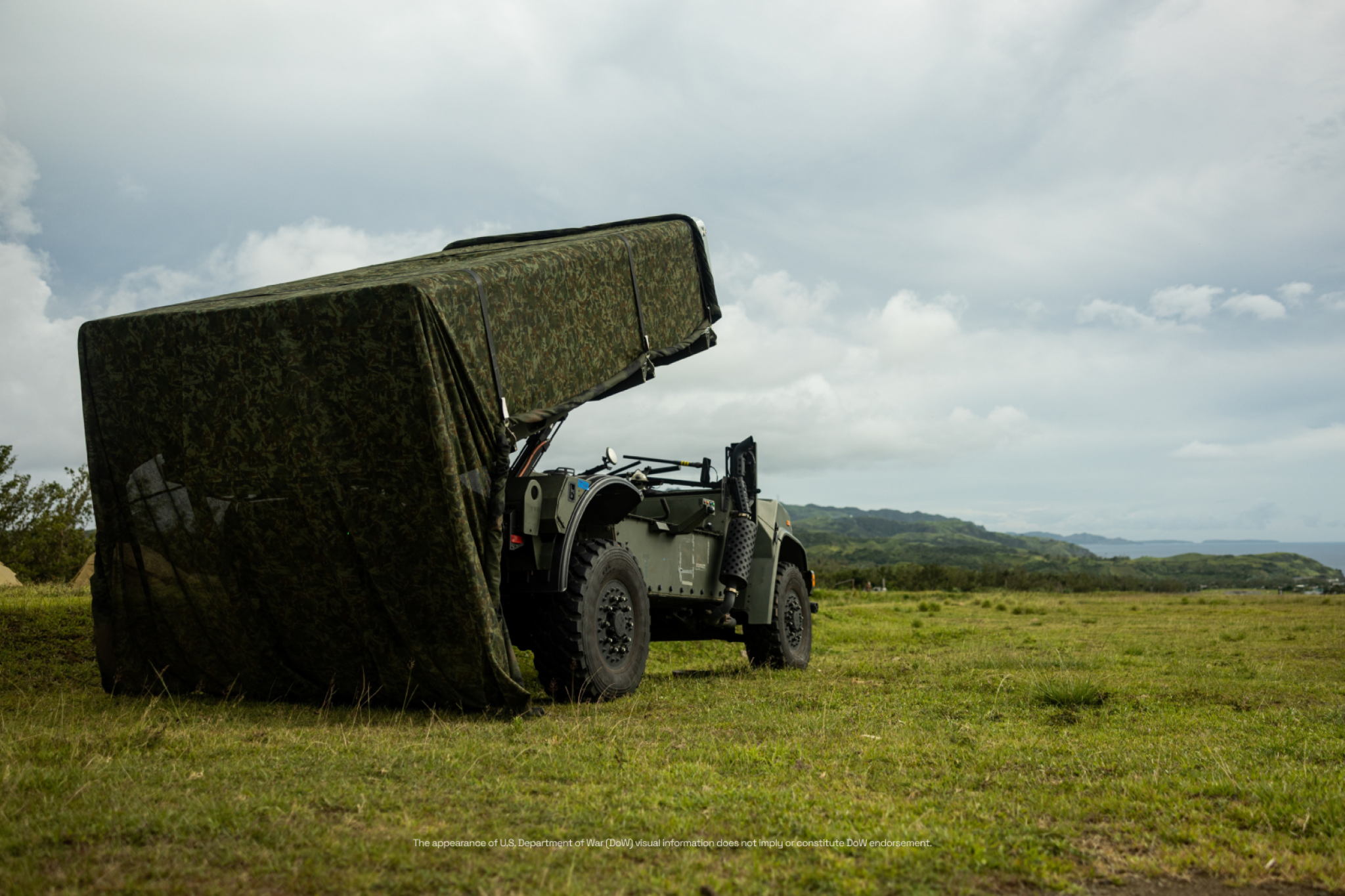
For its part, the Marine Corps has fielded autonomous-enabled platforms like NMESIS and ROGUE Fires. NMESIS gives Marine Littoral Regiments increased sea-denial capabilities against warships, while ROGUE Fires couples long-range precision fires with autonomous resupply routes – lengthening maneuver time and staying off an adversary’s target list.
At the same time, the Defense Innovation Unit’s (DIU) Ground Vehicle Autonomous Pathways (GVAP) project is developing technologies and systems to keep fuel, ammo, and other supplies flowing through 24/7 contested terrain, thereby boosting warfighter endurance and readiness.
DoD leaders have long envisioned uncrewed “wingmen” scouting ahead of units to detect threats and clear hazards before soldiers are exposed – helping map hostile positions, jam sensors, and breach obstacles.
Like UASs, uncrewed ground systems can be used in this way to enhance intelligence, surveillance, and reconnaissance (ISR) coverage. However, unlike UASs, which lose effectiveness when up against the toughest terrain in the Indo-Pacific, AGVs can continue to perform this task even in the most austere environments – including dense-canopy jungle. Even our allies have demonstrated that small robotic ground vehicles can be sent into dense areas that UAS could not penetrate, dramatically improving situational awareness and force protection capabilities.
AGV can further enhance force protection and combat resilience by carrying advanced payloads, including electronic warfare systems, CBRN sensors, and direct-fire weapons. These platforms enhance survivability and mitigate risks to personnel.
Despite underfunding this technology, AGVs are already proving to be force multipliers in the Indo-Pacific. This unique operational utility, to go where other autonomous systems can’t and act as eyes and shields on the ground, delivers a tangible competitive edge today.
So, how can the military accelerate the development and deployment of AGVs?
A ground autonomy roadmap for the DoD
To effectively realize the potential of AGVs, the DoD must aggressively pursue fielding prototypes at scale. New doctrinal frameworks and the revised force structure required to implement them remain theoretical, lacking substantial operational data.
More autonomous ground platforms must be deployed into realistic operational environments, such as joint exercises and forward-deployed contingencies, to capture critical insights on their employment, limitations, and integration into existing force structures.
Accelerating the fielding of various autonomous systems, ranging from small reconnaissance AGVs to large logistical and combat platforms, will yield practical experience necessary to develop robust operational concepts and inform doctrine.
Ground autonomy is not a theoretical future capability; it is an immediate force multiplier. In the Indo-Pacific theater, where distances are vast and force posture is thin, deploying autonomous systems today would inform decisions about how many human formations are truly required, where robotics can replace or augment traditional missions, and how command and control must adapt to support these changes.
Without these concrete operational insights, the Army risks continuing to rely on outdated force structures that do not fully exploit the benefits of autonomy. Instead of speculating on the future of maneuver warfare, U.S. forces should treat AGVs as a tool to reshape maneuver itself—driving a cycle of experimentation, adaptation, and integration that translates into operational advantage.
Autonomy in the air and sea domains has dominated the narrative for years at the expense of U.S. readiness. Ignoring ground autonomy denies the joint force a potent dimension of persistent presence, contested logistics, and forward-based fires. From swarm-based infiltration in dense terrains to amphibious leapfrogs enabled by unmanned supply convoys, the potential of ground systems is enormous.
Unfortunately, institutional inertia, outdated doctrine, and protracted “study phases” continue to hamper progress. An effective offset strategy for the Indo-Pacific demands a true autonomous triad: integrated uncrewed systems across air, sea, and ground. As official statements from DoD illustrate, the technology is already here. Only the will to operationalize it stands in the way.
Congress and the Department of Defense must shift funding, authority, and urgency toward autonomous ground systems in FY26 and beyond. Doctrine must be updated in tandem with fielding, not in its aftermath. Above all, the Joint Force must treat ground autonomy not as a future concept, but as an immediate competitive necessity.
The DoD must pivot from study to execution—updating doctrine and training pipelines, restructuring forces to incorporate ground robotics at scale, and harnessing commercial breakthroughs. The next decade of strategic competition could be defined by whether the U.S. fully embraces ground autonomy or remains stuck in half measures.
OTHER NEWS

Forterra Selected as Prime Contractor for U.S. Army's Engineer Autonomous Breaching Capability Program
rEAD ARTICLE →
Forterra to Support U.S. Army Push to Modernize Infantry Last Tactical Mile Operations
rEAD ARTICLE →