.svg)
Cogs of War: Part 1


AGVs: The Key to Projecting Power Across Multiple AORs
Paul Benefield - VP Strategy.
Since the end of the Cold War, U.S. force projection has relied on a leaner support base. Though U.S. Army Reserve components still account for more than half of its total strength, the Army now funnels reserve mobilizations through only two installations creating a brittle force-generation pipeline ill-suited for rapid, large-scale war.
While the Army has tried to increase unit readiness and develop crisis expansion plans, the fact remains that the physical infrastructure to train, equip, and deploy brigades en masse has shrunk. The net effect is a slower, smaller initial response if conflict erupts. This undermines the “big stick” of U.S. military power if it cannot be carried abroad quickly.
As one War on the Rocks analysis warns, the traditional model of deploying heavy forces from the continental U.S. to distant war zones is “rapidly becoming obsolete” against peer adversaries. Current lift and sustainment limitations make a large-scale expeditionary response both time-consuming and dangerously vulnerable, thereby undercutting U.S. deterrence.
Not only are traditional troop deployments slow, but the weapons systems of peer competitors can target U.S. forces in transit. Swarms of drones, long-range missiles, submarine attacks, and cyber strikes could wreak havoc on convoys and ports, imposing “logistical chaos” as U.S. units try to flow into theater. If adversaries believe they can disrupt U.S. force flow before combat power arrives then deterrence fails.
A Two-Front Force Projection Challenge
The Indo-Pacific is a vast theater with few nearby U.S. bases, meaning most reinforcements must travel thousands of miles by sea or air. China has invested heavily in anti-access/area denial (A2/AD) weapons – namely missiles, naval forces, and integrated air defenses – specifically to deny U.S. forces entry and freedom of movement in a Taiwan contingency.
A recent Army assessment argues that without new approaches, the U.S. would struggle to deploy, fight, and win in a conflict over Taiwan. Simply put, China’s geographic and missile advantages could slow or stop U.S. interventions if America relies on traditional force flow. Even if U.S. forces ultimately arrive, delayed entry could allow China to achieve a fait accompli before meaningful combat power is present.
In Europe, the challenge is less about distance than about scale and speed. NATO’s deterrence against Russia depends on the ability to rapidly reinforce frontline allies before a crisis turns into a fait accompli. In practice, however, moving U.S. heavy brigades to the Baltics or Poland on short notice remains difficult.
While the United States has prepositioned equipment in Europe and expanded its forward presence since 2014, significant gaps persist. Exercises and the early response to Russia’s invasion of Ukraine exposed shortfalls in the logistics, maintenance, and readiness of prepositioned stocks. At the same time, European infrastructure—rail networks, ports, and bridges—has struggled to support the rapid movement of heavy U.S. forces, delaying not just arrival, but the point at which those forces are ready to fight.
The war in Ukraine has fueled calls for more permanently stationed U.S. forces in Eastern Europe. Such steps would strengthen deterrence on NATO’s eastern flank, but they also risk constraining U.S. capacity to simultaneously resource the Indo-Pacific—underscoring the broader two-theater challenge facing U.S. force planning.
If defense budgets do not rise accordingly, prioritizing one theater’s mobilization needs may come at the expense of the other. This resource trade-off underscores why innovative solutions are needed to do more with less – to project power efficiently and credibly in both Europe and Asia despite finite lift and forces.
Leveraging unmanned systems to mitigate the shortfall
Given these constraints, restoring deterrence is less about moving more forces faster, and more about changing what must move at all. Unmanned systems offer a way to project military power with fewer forward-deployed troops and less logistical strain, allowing the Pentagon to deploy fleets of unmanned platforms that extend reach and firepower with a smaller footprint.
While much attention is given to aerial drones, autonomous ground vehicles (AGVs) and other land-based autonomous platforms are emerging as critical contributors to deterrence. These systems can carry hefty payloads, including sensors, missiles, and jammers, and maintain a persistent presence on key terrain. When integrated into a networked, multi-domain force, they punch above their weight.
As conflict technologies evolve, it is telling that U.S. Department of Defense (DoD) leadership is now prioritizing such capabilities.
The Department of Defense has signaled continued high-level support for scaling unmanned systems, with Secretary of War Pete Hegseth testifying that the Pentagon’s autonomous systems efforts have “made enormous strides towards delivering and fielding multiple thousands of unmanned systems across multiple domains, with thousands more planned” in the fiscal 2026 defense budget
This encapsulates the logic: unmanned systems can help address the scaling problem in U.S. force planning, allowing American forces to mass combat power without massing vulnerabilities.
When unmanned vehicles are thoughtfully integrated into command networks and prepositioned for rapid use, they confer several strategic advantages:
Speed and responsiveness: Prepositioned unmanned forces dramatically cut response times in a crisis. By having combat-ready platforms already in theater, the U.S. can respond within hours or days, not the weeks or months a large troop deployment might require.
An unmanned system can lie in wait and activate at the first sign of conflict, denying the enemy any lead time, bolstering deterrence, and complicating any fait accompli strategy. Autonomous systems can compress sensor-to-shooter timelines beyond what human operators alone can achieve thereby accelerating the DoD’s OODA loop.
Cost-effectiveness and scalability: Unmanned platforms are often cheaper to produce and operate. They do not require life-support systems or extensive training pipelines. For instance, a $2 million unmanned coastal defense unit firing a modestly priced missile can disable a warship worth hundreds of times more.
Because they are cheaper, the U.S. can field more of them for the same budget, achieving mass by the numbers. This is crucial for the Indo-Pacific, where vast areas require quantity. In an era of flat or tightening defense budgets, these efficiencies are key.
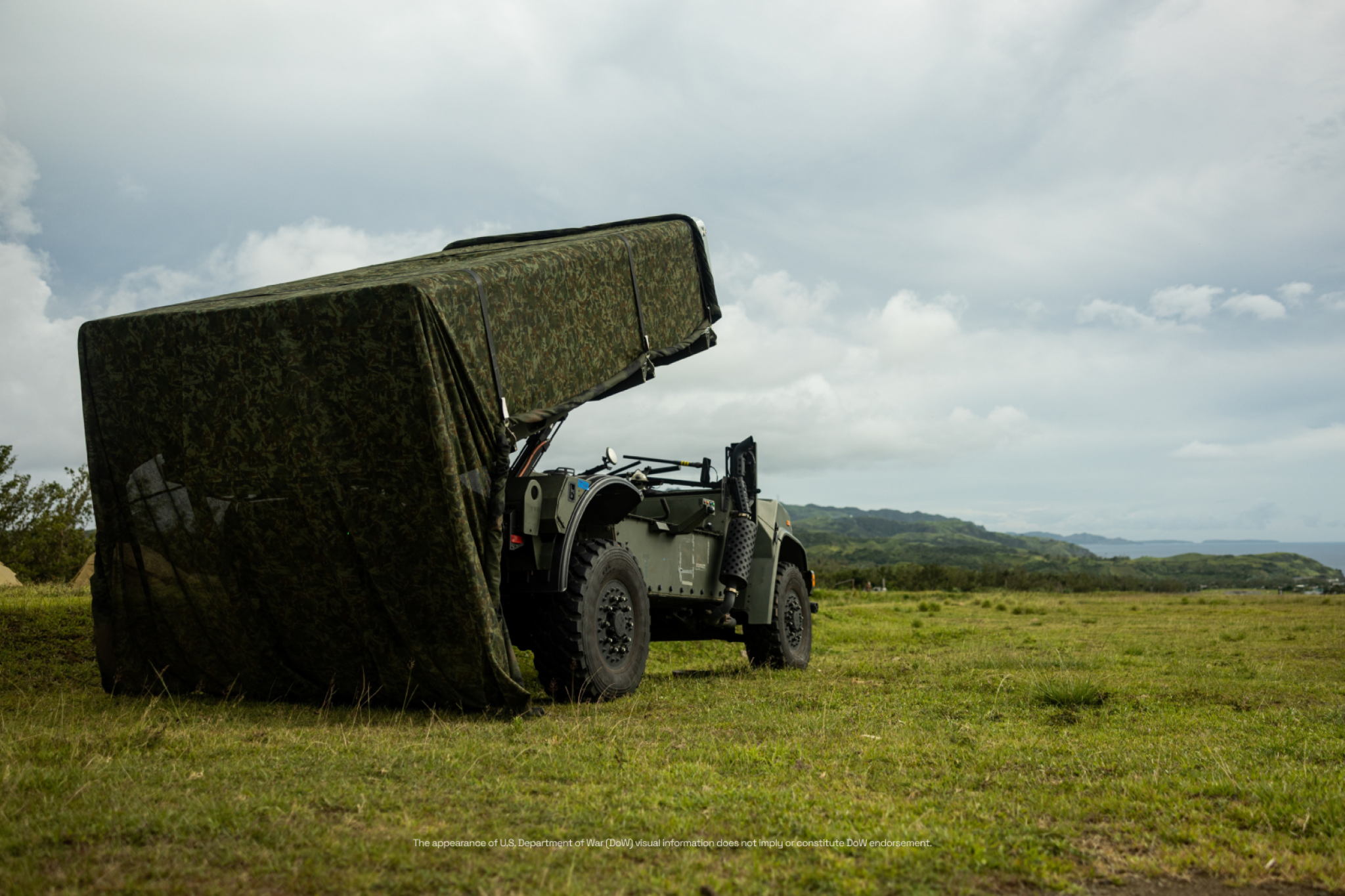
Survivability and reduced risk: Unmanned systems reduce risk to human personnel, and many are inherently harder to detect. A robotic vehicle doesn’t need armor to protect crew, so it can be lighter and stealthier. The Navy/Marine Corps Expeditionary Ship Interdiction System (NMESIS) launcher, for example, is built on a Joint Light Tactical Vehicle chassis with the cab removed, making it compact and capable of “shoot-and-scoot.” Unmanned systems can also operate in electromagnetically silent modes until needed, further reducing signature.
Overall, it’s much harder to knock out dozens of hidden drones or robots than a few big bases or manned platforms. Even if some unmanned units are destroyed, the loss is more tolerable in terms of both dollars and lives. Also, the enemy knows it cannot eliminate U.S. combat power with any single blow.
Strategic ambiguity and deception: Deterrence works by forcing adversaries to hesitate at key decision points. Prepositioned unmanned systems introduce uncertainty into adversary planning. An aggressor may be unsure how many unmanned assets are in a region, what their capabilities are, or even who is controlling them. This ambiguity itself can deter hostile action.
For example, if China contemplates an invasion of Taiwan, it must account for the possibility that numerous unmanned missile launchers, mines, or drone swarms are already in the theater ready to activate, even if U.S. manned forces are far over the horizon. This unknowability makes our military harder to plan for, harder to hit, and harder to beat, forcing the adversary to adopt a more cautious calculus.
Unmanned systems can also be used as decoys or in psychological operations. Inflatable or fake equipment has long been used for deception. Today, actual robotic decoys can maneuver and emit signatures like real units, complicating the enemy’s intelligence picture. In essence, unmanned systems introduce a “fog of war” for the enemy even before conflict begins, by seeding doubt and confusion about invisible capabilities that might be present.
These advantages mean that integrated networks of unmanned and autonomous systems can help restore credible deterrence when traditional means are faltering. They enable the U.S. to act and react faster, cover more area at sustainable cost, and endure attacks more robustly—while keeping adversaries guessing.
However, adopting unmanned, multi-domain systems at scale is new for the DoD, and this strategy will demand adjustments in U.S. defense acquisition and force structure. In my next post, I’ll explore the changes necessary to make this strategy a reality.
OTHER NEWS
Forterra Secures Spot as the Systems Integration Partner for U.S. Army's Joint Readiness Training Center’s Unmanned Systems Program
rEAD ARTICLE →
%201.png)
Forterra Debuts OASIS-OneLink, an Open Communication Architecture Built to Connect Autonomous Military Systems
rEAD ARTICLE →