.svg)
Making the Most of Our $1.5T Defense Budget


Thirty days into a war with Iran, the President of the United States submitted a budget blueprint to Congress that includes $1.5 trillion dollars for defense spending - an approximate 40 percent increase from previous years. According to recent coverage of the budget proposal, this increase is intended to, “…bolster munitions and build out the US naval fleet while also beginning construction on[the] planned ‘Golden Dome’ missile defense system.”
These record defense budgets raise interesting questions about the cost of modern weapons systems, what is needed to compete against increasingly capable peer and near-peer adversaries, and whether there are ways to generate greater return on the military’s investment.
Forterra VP of Strategy Paul Benfield recently sat down with retired United States Marine Corps (USMC) Lieutenant General (LtGen, Ret) Mike Dana to discuss the challenges facing today’s military and the investments required to address them. Their conversation examined how increasingly capable adversaries are driving continued reliance on high-end air and maritime systems, while also highlighting the opportunity to improve cost-effectiveness by integrating emerging technologies. In particular, they discussed how integrating emerging technology alongside legacy systems, rather than replacing them outright, can extend capability, enhance operational flexibility, and deliver greater returns on defense spending as part of a broader modernization approach.
Paul Benfield: The current administration is requesting $1.5 trillion in defense appropriations. What about our current threat landscape makes that much money necessary?
LtGen. Mike Dana: If you look back at World War II, the individual weapon systems we had were relatively low-cost, very durable, and not overly complex. There were exceptions, like some airframes, but for the most part, it was about producing mass at scale to compete against a peer adversary; in that case, Germany and Japan.
Today, the threat environment looks very different. Many of the systems we rely on are incredibly expensive, such as the Virginia-class submarine and advanced aircraft like the F-35. Just to procure, maintain, and operate these highly sophisticated platforms costs an enormous amount of money.
At the same time, today’s threat is truly multi-domain. You can be seen, targeted, and engaged in ways that make survival much more difficult. Adversaries can disrupt communications, degrade your command-and-control systems, and create environments where your C2 is effectively down. The lethality and precision of today’s munitions far exceed anything we’ve seen before. So, the U.S. Department of War needs to plan and equip itself to face threats.
When people hear $1.5 trillion, it sounds like a lot, but that budget gets depleted quickly. There’s not as much discretionary funding as people might think. You still have to pay and support the troops, and there’s significant overhead across the military.
In today’s dollars, we spent $6 Trillion in WWII…and that doesn’t count the pre-war build up.
Paul Benfield: What operational challenges arise for our military as our adversary’s capabilities, like area denial and electronic warfare systems, become more advanced?
LtGen. Mike Dana: It increases the complexity of the threat because everything becomes contested. Warfare has been around for thousands of years, but what’s different today is that you’ve got both kinetic and non-kinetic means to destroy, defeat, delay, and confuse forces on the battlefield.
We have these very advanced C5ISR-T capabilities. In other words, our ability to command, control, communicate, target, and conduct surveillance is incredibly strong. But the reality is, today, so does the enemy. That’s what’s changed.
So now it really becomes an arms race, not just in the kinetic sense, but across the non-kinetic domain as well; cyber, electronic warfare, information operations. All of that is in play at the same time.
And what that means operationally is that we have to be able to function in contested environments while still maintaining both defensive and offensive capabilities. It’s no longer enough to be dominant in one domain; you have to be able to create overmatch in all domains. This overmatch is driven by the ability to generate as much simultaneity as possible in a multi-domain fight.
Paul Benfield: When thinking about near-peer threats like China and Russia, particularly in the U.S. Indo-Pacific Command (INDOPACOM) region, what unique challenges does the “tyranny of distance” create for U.S. forces, and how does that impact our ability to operate effectively?
LtGen. Mike Dana: The tyranny of distance is timeless. Even as we become a leaner, precision-focused military, we still have to move a lot of sustainment from point A to point B. We have to move troops, equipment, everything.
In a Pacific fight, the key difference is that China will operate on interior lines of communication, while we’re operating on exterior lines. That means their ability to resupply, reinforce, and move forces is faster and requires less distance. Meanwhile, we’re projecting power across the entire Pacific.
I saw a map recently that superimposed the United States onto the Pacific, and it really puts things into perspective. The scale is massive. For example, it takes about 21 days for a ship to go from San Diego to Okinawa. So, it’s not just the tyranny of distance, it’s the tyranny of time. It simply takes a long time to move from point A to point B.
That said, we do have some advantages. We’ve spent years preparing the logistics for the battlespace. We understand the key modes and nodes of transportation and communication across the region. We know where we’ll operate, just as our adversaries do, but once we’re in place, we can take steps to harden those nodes and facilities.
At the same time, modern threats complicate this. Today’s missile technology, especially hypersonics, is a real concern. With hypersonic weapons, you don’t have much decision space; you have very little time to detect, decide, and respond. That creates a significant challenge for defense.
One way to think about countering that is through scale, particularly with unmanned systems. If you’re facing hypersonic threats, having large numbers of unmanned interceptors that you can employ quickly could be one way to address that problem.
Paul Benfield: How can AGVs help our military fight and win against adversaries with advanced electronic warfare (EW) capabilities and area denial and area access capabilities?
LtGen. Mike Dana: When it comes to autonomous platforms in a high-threat, contested environment, you’re putting a machine where a human would be. That matters, because now you can test, examine, and really understand enemy defenses across every domain, kinetic and non-kinetic, without putting people at risk.
Those systems are feeding data back to humans in a command-and-control environment, but they give you the ability to explore and exploit enemy defenses at a much lower cost, both in terms of dollars and, more importantly, human life.
With autonomous platforms, you’re getting multiple capabilities at once. And I’d argue that it’s easier to scale than it is with human forces. You can employ unmanned systems across all domains - air, ground, sea and sub-sea
As capable as humans are, combat is inherently chaotic. Machines don’t get confused like humans. You give them a mission, and they execute. However, the perfect machine would be able to display judgment, currently something only humans can do in combat.
If you’re able to flood the zone with hundreds of autonomous systems, of different types and modalities, that becomes incredibly powerful. It allows you to concentrate force, create effects at scale, and operate in environments that would otherwise be too dangerous or too complex for traditional forces alone.
Paul Benfield: Considering those benefits, do you think there’s too much focus and investment in exquisite air and naval systems? Should those defense dollars be used on ground autonomy, instead?
LtGen. Mike Dana: I don’t really see this as a binary choice. The U.S. military, our Joint Force, is always going to be a blend of high-end and low-end warfighting systems. You’re still going to need aircraft carriers and advanced aircraft like the F-35. Whether their survivability evolves over time is a fair question, but we’re not walking away from those platforms.
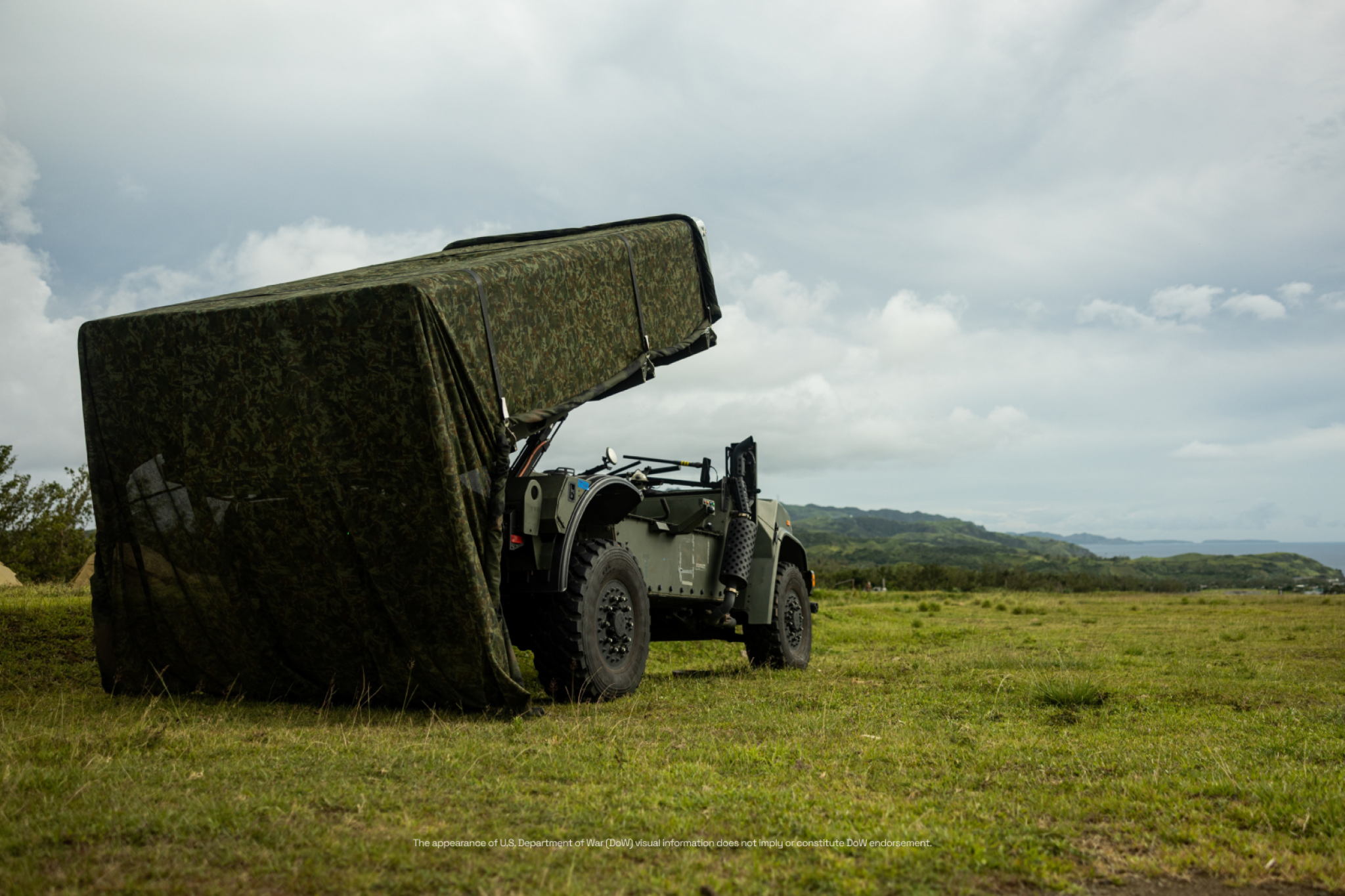
Systems like expeditionary and autonomous ground systems offer a strong return on investment because they can be built at a lower cost than high-end platforms. They deliver significant operational and tactical value. These systems can be used for reconnaissance, as sensors, as shooters, or even as basic logistics vehicles moving supplies and sustainment from point A to point B. They cost just tens of thousands of dollars per system in some cases; that’s a compelling capability within a trillion-dollar budget.
At the same time, we’re not just going to shift entirely to unmanned systems either. To me, it’s a complementary blend, manned and unmanned, exquisite and less exquisite platforms. You want a broad menu of capabilities to choose from to generate operational tempo, improve decision-making, and increase lethality. It’s not an “either-or” situation.
However, it’s fair to say that ground systems should keep pace with the significant investments our military has made in air and maritime capabilities over the years. If we’re increasing the defense budget, and especially if this is a once-in-a-generation opportunity through acquisition reform, then we need to ensure we create space for these ground-domain systems as well.
---
LtGen Dana retired from the United States Marine Corps on 1 September 2019. He graduated from Union College in Schenectady, New York and was commissioned a Second Lieutenant in June of 1982. In a career spanning thirty-seven years he served as an armor officer, a logistics officer, and a strategic planner. As a three-star General Officer he served as the Deputy Commandant for Installations and Logistics (DC I&L) and as the Director of the Marine Corps staff (DMCS). Over his thirty-seven-year career LtGen Dana deployed ten times, including seven humanitarian, peacekeeping, or combat deployments. He commanded Marine Wing Support Group 37 in Iraq in 2006/7 and 2d Marine Logistics Group in Afghanistan in 2011/12.
LtGen Dana is a school trained strategic planner. As a Brigadier General, he served as the Director of Logistics for US Northern Command in Colorado, Springs, Colorado. He also served as the Director of Strategy and Policy for US Pacific Command in Hawaii, where he and his team developed theater security cooperation, contingency, and crisis action plans with regional allies in the Pacific. LtGen Dana is a graduate of the School of Advanced Warfighting and the Naval War College
OTHER NEWS
Forterra Secures Spot as the Systems Integration Partner for U.S. Army's Joint Readiness Training Center’s Unmanned Systems Program
rEAD ARTICLE →
%201.png)
Forterra Debuts OASIS-OneLink, an Open Communication Architecture Built to Connect Autonomous Military Systems
rEAD ARTICLE →