
.svg)
.svg)


Capability becomes modular.
Integration stops being a program.
Closed stacks turn every new capability into another integration program, with license fees and locked-up data. OASIS breaks that pattern. Fires, sensors, comms, forward power, and edge compute integrate once, over open MOSA-aligned interfaces. No license fees, and the government owns its data outright.

Unified data layer for every system
Fabric connects systems through a shared data layer. Each system uses one adapter to share data in its native format, eliminating the need to build a separate connection to every other system. Fabric is open source, with no license fees. The government retains ownership of its data and the freedom to use it with other providers.
Data moves without translation. Consumers negotiate the schema they need; the source is never rewritten to suit them.
When a link drops, traffic reroutes and buffers at the edge, then reconciles on reconnect. Throughput falls. Delivery does not.
Publishers decide who reads what, down to the field. Sharing is a policy decision, not a side-effect of being connected. The data stays the government's, never the vendor's.

Extensible command and control
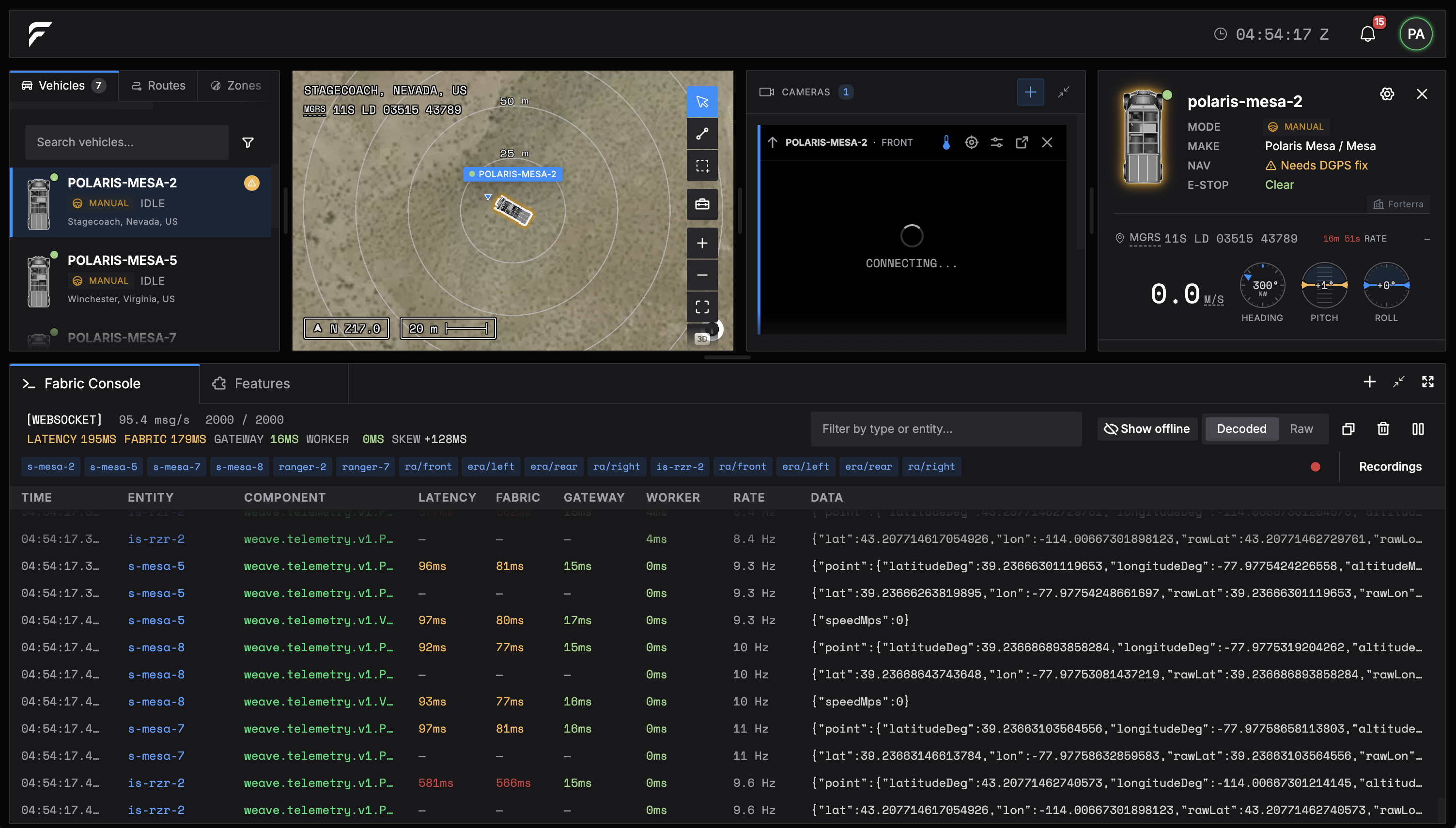
A single window into autonomous vehicles, payloads, mission applications, and the command systems already in place. Extensions dock alongside the tools you already run. Nothing gets replaced, and nothing is reconciled by hand.

One operational picture across AutoDrive, Vektor, Fabric, and partner applications: every source in the same frame, not reconciled by hand.
Build routes, zones, and convoys, then control multi-phase missions on a live timeline. Pause, skip, or advance any task from the same view.
Every vehicle live on one map. Camera selection per platform. Position, speed, heading, and nav state, updating as it happens.
Nothing moves without an operator confirming it. Autonomy proposes the action; the person in the seat decides, every time.
Validation before fielding
The Virtual Integration Environment acts as an operational surrogate, where new payloads, behaviors, and partner systems are integrated and exercised in simulation against the same interfaces they will meet in the field. What fails costs compute. What passes is deployed into the live stack as the artifact that was tested.
Stand up the vehicle, the payload and the network conditions you will actually face, including the degraded ones.
Run the mission hundreds of times before it runs once. Failure here costs compute, not equipment.
Behavior is measured against the same OASIS interfaces it will meet in the field. No separate test harness to maintain.
What passes moves into the live stack unchanged, and the fleet gains a capability it has already flown.
Intent-driven mission autonomy
State the outcome. Mission Autonomy resolves the routing, phasing, and vehicle assignment against the live picture, then holds the finished plan for an operator’s confirmation before anything moves.
Commander’s intent in plain language, resolved into a sequenced plan against the picture Fabric is already carrying.
The output is phased, with dependencies, timing, and fallbacks, not a list of coordinates for someone else to sequence.
No phase releases until an operator confirms it. Autonomy proposes. The operator decides, every time.
When the route, the threat, or the fleet changes, the plan re-solves against the live picture and returns to the same gate.
.svg)




.svg)