.svg)
Attritable Is Not a Price Point


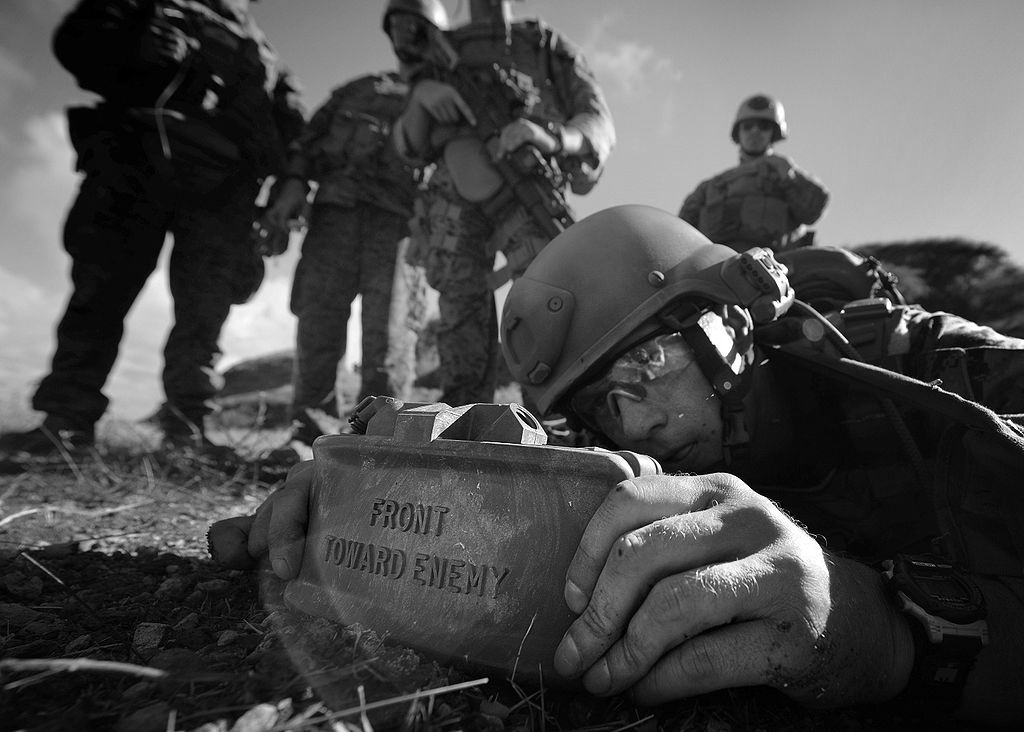
The M18 Claymore mine has one job and one very simple warning, and it’s molded directly into the plastic: FRONT TOWARD ENEMY.
It is a definition simple enough to survive exhaustion, repetition, and the middle of the night: exactly the conditions a Soldier actually operates under.
Defense acquisition models need the same kind of foolproof instructions for defining attritability. Right now, attritability means whatever the seller or buyer needs it to mean: cheap, unmanned, procured in bulk, or simply "not the exquisite thing." The looseness of this term is steering procurement decisions in ground autonomy in the wrong direction.
The Department of War has, for the most part, defaulted to unit cost as its primary acquisition lens, and the results speak for themselves. A June 2025 GAO analysis found that costs for 30 major defense programs rose a combined $49.3 billion in a single year, and that programs still in development now take over ten years, on average, to deliver - despite reforms meant to speed things up.[1] A June 2024 GAO report found these delays are getting worse, not just staying flat.[2]
That habit has deep roots. American defense acquisition has spent the better part of 75 years optimizing for exquisiteness: the longest-range artillery, the most survivable armored vehicle. The Bradley Fighting Vehicle took nearly two decades to field. The F-35 program is now projected to cost over two trillion dollars across its lifecycle. Both are predictable outputs of a framework that counts dollars spent but not time lost, capability delayed, or risk carried in the interim.
Autonomous ground systems are entering that same acquisition culture, evaluated by the same archaic criteria. What is missing is not more enthusiasm for autonomy. It is a working definition of what "attritable" actually requires. One specific enough that a program office, an appropriator, and a squad leader would all reach the same answer looking at the same system.
Attritability is not a price tag
Attritability is not a dollar threshold. It is a function of four variables that all have to hold at once:
- Effect
- Human life
- Capital
- Speed
A system that performs well across all four thresholds is attritable in any sense that matters operationally. A system that fails on even one is not “bad.” It’s just not attritable. This model provides a useful litmus test for attritability that can be practically operationalized.
Effect comes first because nothing else matters if the system can't do the job. An unmanned platform that only partly replicates what a crewed system delivered isn't attritable - it's potentially an operational downgrade with an attritability label slapped on it. Cost savings, faster production, and zero risk to a crew mean nothing if the mission doesn't get done. This metric also captures the “size” of the operational impact of the system doing its job (e.g., a Hellfire striking a high-value target has a larger effect than a small drone delivering a battery, generally).
Human life is the variable acquisition models are worst at capturing, and the one that matters most to anyone who has actually sent people into harm's way. A vehicle with no one aboard does not require a V-shaped hull or an armor upgrade to protect a crew.
Capital is the honest cost of losing the system, not its sticker price: what it costs to replace, and what it would have cost in support infrastructure and manned operation to avoid losing it in the first place. It should capture the cost-at-risk when using a system.
Speed is how fast the loss can be made irrelevant. A system built on an active, commercially adjacent production line can be replaced before the gap matters operationally. A legacy exquisite system can't be replaced on that timeline, no matter how affordable its unit cost looks on paper.
Putting attritability to the test
The plot graph above maps ten example systems across three mission sets (long-range fires, breaching, and contested logistics) on three axes: battlefield effect, risk to human life, and cost at risk per mission. A tilted plane marks the attritability threshold: circles clear it, diamonds don't. Because risk to life carries twice the weight of effect in setting that plane, even a small amount of "someone's aboard" sharply limits how much cost a system is allowed to carry, however effective it is.
Because the formula for this plane can be challenging to use practically, we suggest a qualitative framework as a good heuristic. Below is a scoring system that determines attritability levels through various threshold assessments. Basically, score each system across four categories, then apply one rule: it must clear at least Level 2 on effect, capital, and speed, but Level 3 - the top level - on life. Life alone isn't tradeable against the others: a system can fall short on cost or speed and still be attritable, but one that risks a life can't be, no matter how well it scores elsewhere.
Effect - does it deliver a comparable or better mission effect than the manned system it stands in for?
- Threshold 1: — Materially degraded capability relative to the manned baseline.
- Threshold 2: — Comparable capability, with acceptable trade-offs.
- Threshold 3: — Equal or superior capability.
Human life - does employing it put anyone's life on the line, at any point in the mission?
- Threshold 1: — Crew required aboard, or personnel required forward and exposed to fire to employ it.
- Threshold 2: — Personnel are nearby or in support, but not aboard or directly forward.
- Threshold 3: — No one's life is on the line at any point in employment.
Capital - what does losing it actually cost, in terms genuinely at risk per mission, not sticker price?
- Threshold 1: — A loss triggers a budget event: reprogramming, congressional notification, program-level disruption.
- Threshold 2: — A loss is absorbed inside the existing program budget without external event.
- Threshold 3: — A loss is a routine sustainment cost, priced in from the start.
Speed to replace - can the supply chain turn out a replacement on a militarily relevant timeline?
- Threshold 1: — Multi-year restart; a cold or low-rate legacy line.
- Threshold 2: — Production can surge within roughly a year of sustained demand.
- Threshold 3: — An active line replaces losses in weeks to months.
Two legacy systems, one test
MICLIC. The Mine Clearing Line Charge has cleared minefields for the American warfighters for decades. The effect remains relevant, it still works and it continues to be deployed in the battlefield. It’s essentially a rocket-projected line charge that opens an eight-meter by hundred-meter lane through a minefield in one shot. Let’s run it through the test.
On effect, it clears Level 3 outright. It is a proven, decades-validated breaching capability. On capital, a single line charge costs roughly $83,000, a figure inside Level 3. Losing one is a routine consumable cost, not a budget event.[3] On speed, it is a mature, simple munition with an established production and logistics tail, comfortably Level 2 or better. It fails, however, on life, and therefore fails outright. Employing a towed MICLIC requires an engineer squad to move the trailer forward, rig the line charge, and fire it, forward of the line of departure, inside the minefield's effective range, under the suppression, obscuration, and security measures that exist for no other reason than to keep that squad alive long enough to do the job. That is Level 1 by definition: personnel required forward and exposed to fire.
MICLIC is, by unit cost, one of the cheapest systems in this entire framework, but it fails the attritability test. Cost was never the variable holding this system back from being called attritable. The Soldier in the breach lane is. However, when you put the same MICLIC on an unmanned, autonomous vehicle platform, now you have a system whose effect offsets the cost and human-life trades to become attritable.
HIMARS and ROGUE-Fires/NMESIS. Long-range precision fires make the same point from the opposite direction: an expensive, exquisite system that still fails on life, next to an autonomous alternative that clears the bar.
HIMARS is a devastating and combat-proven system, with an effective range up to 300 kilometers depending on munition and a strong claim to Level 3 on effect. It requires a crew of three, commander, gunner, and driver, riding the launcher into firing position.[4] That is Level 1 on life, full stop, and no amount of capability elsewhere in the scorecard offsets it under this test given the threat of counter-battery fire on the modern battlefield. On capital, a launcher runs roughly $5 million in current-year Army budget figures, and losing one is unambiguously a budget event requiring reprogramming, Level 1. On speed, it’s at best a Level 2: production is active but constrained to a defense-specific line with year-plus lead times for new orders.
ROGUE-Fires, Oshkosh and Forterra's autonomous ground vehicle-based fires platform, pairs a Naval Strike Missile with an unmanned, JLTV-based carrier. On effect, it delivers a comparable anti-ship denial capability using an already-fielded, combat-relevant missile, Level 2 to 3. On capital, the Marine Corps' most recent Block II production award covered 178 carrier vehicles for $92 million, a real, publicly reported figure that works out to roughly over $1 million per unit, comfortably inside Level 2 to 3: losing one is absorbed inside an active production contract, not a special budget action.[5] On speed, that same contract represents the largest public production award for ground autonomy the military has made, on a commercial-derived chassis with an active line, Level 2 to 3. And on life: no one rides in the vehicle. A human remains in the loop for the missile-launch decision itself, which is worth stating plainly rather than implying the system removes people from the kill chain entirely, but no one is aboard the platform or forward of it at the point of employment. That is Level 3.
Run side by side, the two systems land in almost opposite places for almost opposite reasons. HIMARS is exquisite, effective, and expensive, and fails the test on the one variable that cannot be traded away.
What this means for anyone who signs the check
The wrong question in a budget review is why a system costs MORE than the cheapest thing that could technically do the job. The right question (for anything meant to be attritable), is whether it clears the bar on all four counts.
Senior leaders already reason this way operationally. Every experienced commander has weighed risk to force against mission effect under pressure, in real time, with real consequences. The gap is that the acquisition frameworks in formal use do not require that same reasoning to be applied, recorded, and compared alongside unit cost when a program is built. That gap systematically favors exquisite systems, which are easy to cost, over attritable ones, whose value shows up in variables standard models don't measure at all.
The fix doesn't require new bureaucracy - just evaluating effect, life, capital and speed with the same rigor as unit price and treating life as the floor it actually is. It’s not another line item to trade against the rest. Attritable was never a price point. It's an outcome. Anyone can build something cheap. The test is whether it still does the job, can be acquired for a fair and reasonable price, still gets replaced in time, and sustains life in the battlefield.
[1]GAO Weapon Systems Annual Assessment, June 2025 (GAO-25-107569).
[2]GAO Weapon Systems Annual Assessment, June 2024 (GAO-24-106831).
[3]Per-unit cost of the M58 MICLIC line charge, FY2018 figure.
[4]M142 HIMARS crew size and current-year unit cost, per Army budget justification documentation.
[5]U.S. Marine Corps Block II production award to Oshkosh Defense and Forterra, 178 total units for $92 million.
OTHER NEWS

Forterra Selected as Prime Contractor for U.S. Army's Engineer Autonomous Breaching Capability Program
rEAD ARTICLE →
Forterra to Support U.S. Army Push to Modernize Infantry Last Tactical Mile Operations
rEAD ARTICLE →