.svg)
ROGUE-Fires Hails a New Era of Autonomy for the Marine Corps


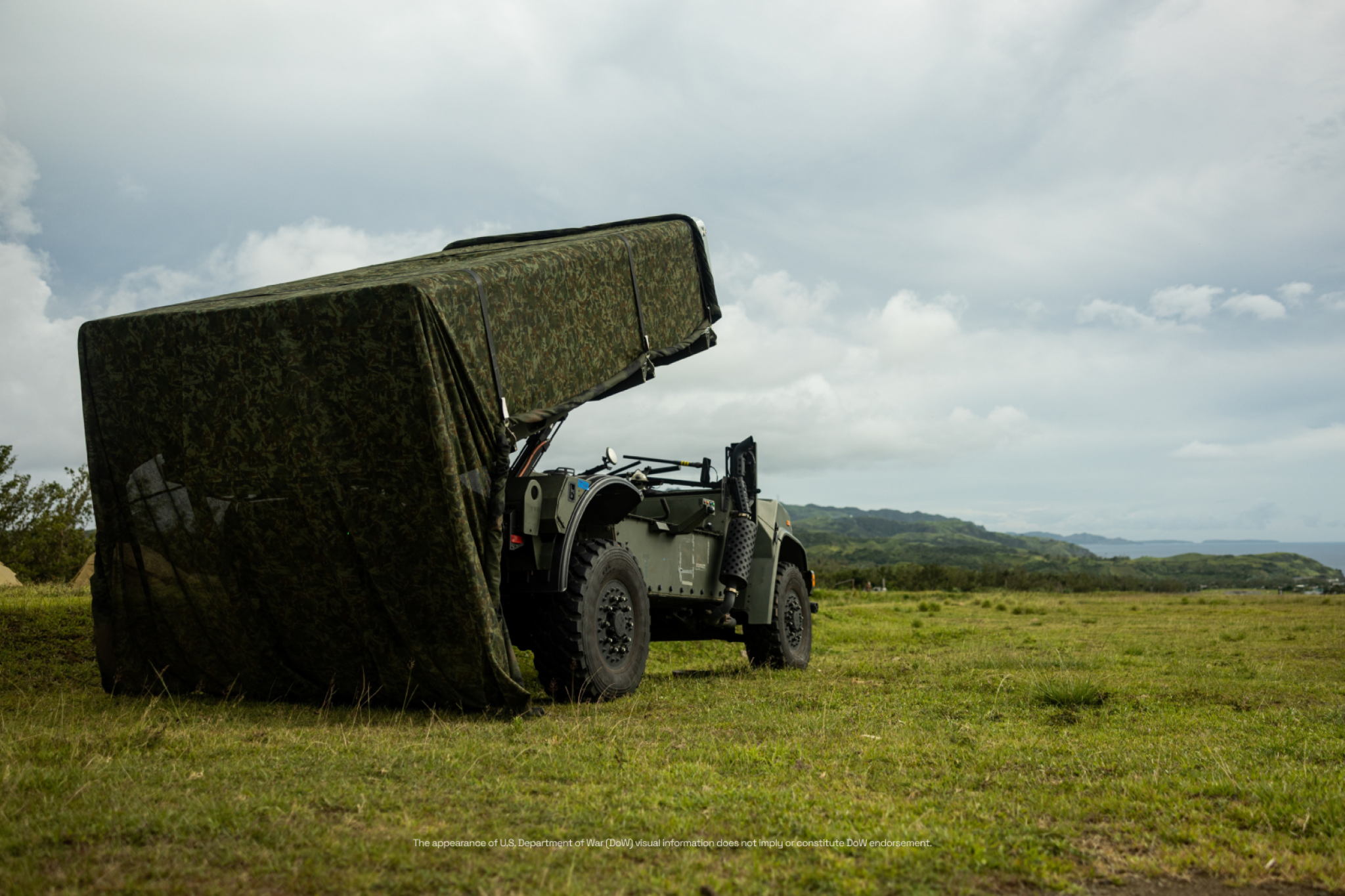
Last month, the U.S. Marine Corps took a major step toward greater adoption of ground autonomy, awarding Oshkosh Defense and its autonomy partner, Forterra, a ROGUE-Fires Block 2 production contract. The award expands the service’s autonomous fires capability and marks an important milestone for the partnership behind the ROGUE-Fires platform.
But the significance extends beyond a single program. As the U.S. military prepares for future conflicts against sophisticated peer and near-peer adversaries, autonomous ground systems are becoming increasingly integral to the future fight—serving as a force multiplier, increasing survivability, and reducing the number of warfighters placed directly in harm’s way.
To learn more about the Oshkosh Defense and Forterra partnership, ROGUE-Fires, and what the Block 2 award could signal for the future of ground autonomy, we sat down with Patrick Williams, Chief Program Manager at Oshkosh Defense, and Christian Seifert, VP of Autonomous Mobility at Forterra.
Modern Integrated Warfare (MIW): What is the Remotely Operated Ground Unit for Expeditionary Fires (ROGUE-Fires) weapon system? What capabilities does it offer?
Patrick Williams: ROGUE-Fires is a capability we developed specifically for the U.S. Marine Corps, and it represents a generational step forward in mobility and weapons system platforms. It is the first fielded autonomous mobile weapons launcher designed to carry long-range precision fires in support of the Marine Corps’ mission.
The system consists of two components: the Naval Strike Missile (NSM) munition integrated onto the platform and ROGUE-Fires itself, which serves as the mobile, remotely operated launcher. The platform combines the off-road mobility of the Joint Light Tactical Vehicle (JLTV) with advanced autonomous capabilities.
Christian Seifert: That was a great introduction by Patrick. But I think it’s important to stress that, while ROGUE-Fires is an unmanned launcher platform by definition, it represents something bigger than that. It’s the first unmanned launcher program that any of the services has pushed into production.
It makes sense that the Marine Corps pursued this capability because they're accustomed to moving fast and they recognized what their operating concept in the littorals would require. As a relatively small organization, they needed a capability that didn't require many people to operate. They had to optimize their force structure to accomplish the mission without increasing the overall size of the force.
MIW: Is ROGUE-Fires replacing an existing weapon system, or is it a new solution for our military? Why choose an autonomous solution for this use case?
Patrick Williams: When you think about Marine Corps Force Design and some of the mission sets the Marine Corps is shifting toward, they require a new level of mobility, autonomy, and capability. We're talking about distributed units and distributed fires across larger geographic areas, including anti-access and area-denial mission sets.
So, while they are always replacing a vehicle that currently exists in some capacity, ROGUE-Fires introduces a new capability designed to meet that evolving operational concept. It provides another way to deploy existing munition systems and solutions while giving the Marine Corps the mobility and autonomy those missions require.
That capability is particularly important when you consider the Marine Corps’ mission in environments such as the Indo-Pacific. ROGUE-Fires enables autonomous movement and rapid maneuver, giving Marines the ability to position the system, deliver fires, and quickly relocate.
Equally important is the ability to separate Marines from the munition and launch site. Counter-battery fire is highly effective, so you don't want Marines physically located on a launcher that could be targeted. ROGUE-Fires increases survivability by allowing Marines to command the system from a safer distance.
Christian Seifert: Building on Patrick’s point about the Marine Corps’ evolving operational concept, ROGUE-Fires reflects a broader shift in how the service expects to operate into the future.
A few years ago, the Marine Corps decided to divest its tanks and invest in capabilities better suited to the future fight. It represented a fundamentally different approach, including giving Marines the ability to defend and control key waterways from the land.
Autonomy makes a lot of sense within that concept because Marines are expeditionary by nature. They deploy aboard naval ships, where both physical space and personnel are limited. The Marine Corps can't simply add more Marines every time it adds another capability. Autonomy enables the same number of Marines to control more systems and generate greater effects.
There is also the survivability component Patrick touched on. The more dispersed your forces are, the less of a concentrated target they become. Autonomy takes that a step further by allowing the Marine Corps to separate its strike capabilities from its people. This creates targeting dilemmas for adversaries because they now must decide where to expend a limited number of munitions, against people or against equipment.
The ability to continually move those autonomous systems makes that problem even more difficult. By the time an adversary launches a munition against a ROGUE-Fires position, the launcher could have already displaced to another location or moved into a concealed position. In that sense, you're trying to force the adversary to expend valuable munitions against something that may no longer be there.
MIW: I understand that ROGUE-Fires can carry the Navy-Marine Expeditionary Ship Interdiction System (NMESIS). What role will this system play in future operations against sophisticated peer and near-peer adversaries?
Patrick Williams: The NMESIS is the combination of the ROGUE-Fires platform and the NSM. Together, they provide commanders with a highly mobile, difficult-to-find, and difficult-to-target precision-strike capability.
When you consider the Marine Corps’ mission in the Indo-Pacific, particularly across island chains and in anti-access/area-denial mission sets, the ability to distribute fires and engage enemy shipping becomes extremely important. NMESIS is part of the Marine Corps’ Force Design modernization efforts to provide those autonomous, distributed, and dispersed fires, particularly for sea denial and coastal defense in congested island-chain environments.
It also gives commanders greater flexibility. Instead of relying solely on ships or aircraft for fires, commanders gain island- or ground-based capabilities that can create uncertainty for adversaries and help defend large portions of the Indo-Pacific region. The NSM itself is a multi-mission cruise missile with sea-skimming and evasive maneuvering capabilities, making it difficult to defend against, even for a near-peer adversary.
MIW: Since ROGUE-Fires is modular by design, what other effectors, weapons, and payloads can be carried by the platform?
Patrick Williams: When we developed ROGUE-Fires with our Marine Corps partners, we envisioned it as a Swiss Army knife approach: a common autonomous mobility platform that can be adapted to fill a wide range of mission roles, particularly in distributed operations, and give commanders options depending on the mission. It was developed to accommodate everything from a Multiple Launch Rocket System (MLRS) package to the NSM and even larger, long-range missiles.
That flexibility was purposeful. NMESIS addresses the specific mission set we just discussed, but the same platform could potentially replace current High Mobility Artillery Rocket System (HIMARS) launcher platforms with an autonomous, lighter, and smaller package.
There is also a logistics advantage, particularly when warfighters operate in a forward area. We talk a lot about contested logistics and distributed operations, which make maintaining and supporting multiple platforms increasingly complex. Having a common launcher and mobility platform that can support multiple missile and munition packages can simplify the maintenance, logistics, and support tail.
It also gives the military flexibility as the fight evolves. We know what the battlefield looks like today, but the conflict in Ukraine demonstrates how quickly it can change. An autonomous, flexible, and mobile platform enables military forces to incorporate emerging technologies, new capabilities, and payloads as requirements evolve.
That could extend well beyond missiles. Could it support a counter-UAS capability? Sure. Could it perform logistics resupply? Absolutely - replace the missile package with a flatbed. It could also support ISR, electronic warfare, or any number of different sensor packages.
MIW: I understand that other industry partners developed ROGUE-Fires prototypes. Why was the Oshkosh Defense and Forterra ROGUE-Fires solution selected by the U.S. Marine Corps for production?
Christian Seifert: Forterra and Oshkosh had experience working together before ROGUE-Fires. Forterra had previously been selected for the Autonomous Tactical Vehicle Sustainment (ATVS) Program, in which we integrated our autonomy technology into Palletized Load System (PLS) trucks produced by Oshkosh.
That gave us a lot of experience working with Oshkosh from a technical standpoint and integrating our autonomy kit onto their vehicles.
When the U.S. Marine Corps began pursuing this capability, they looked for ways to gain efficiencies in cost, schedule, and performance by leveraging technologies that had already been developed and matured. The Army had already done some of that work through ATVS, so there was an opportunity to take what had been learned and apply it to the Marine Corps' requirements.
Oshkosh was already producing the Joint Light Tactical Vehicle (JLTV), and the Marine Corps wanted to leverage that common chassis. Forterra's autonomy technology had already been integrated with Oshkosh vehicles, and the drive-by-wire system—the connection between the autonomy system and the vehicle itself—was generally the same.
That meant we weren't starting from scratch. The U.S. Marine Corps could bring together two mature technologies that had already been competitively selected and partially validated, integrate them, conduct the necessary testing, and then add the weapon system.
MIW: Forterra's AutoDrive platform is the backbone of the ROGUE-Fires platform's autonomous capabilities. Why did Oshkosh Defense choose the Forterra AutoDrive solution for ROGUE-Fires?
Patrick Williams: When you take a step back and look at what the government is asking for today, they're not looking to buy a vehicle from one company, autonomy from another, and a weapon system from somebody else. They're looking for an integrated system that delivers a capability.
Our experience working with Forterra meant we already had that partnership and integration experience in place to leverage for ROGUE-Fires. I like to think of it as bringing together two great professional athletes, for lack of a better term. We each bring a different area of expertise to the system, and Forterra has been an outstanding partner in bringing those capabilities together.
Oshkosh brings the mobility platform, vehicle interfaces, and drive-by-wire capabilities, while Forterra brings the technology and autonomy stack. Combining those complementary areas of expertise has created an experienced team that was uniquely qualified to provide the Marine Corps with the integrated capability it needed.
MIW: Is this award for ROGUE-Fires an isolated thing, or indicative of a larger trend and movement towards ground autonomy by the U.S. Department of War?
Christian Seifert: I see ROGUE-Fires as part of a much larger trend. In the past, you might have had standalone units responsible for long-range fires or air defense, and then you had to integrate those capabilities. What we're seeing in Ukraine and other conflicts is those capabilities becoming increasingly distributed across the force. We're also seeing autonomous systems become part of that shift across the air, ground, and littoral domains.
Everyone is familiar with first-person view military drones (FPVs) and small unmanned aerial systems (UAS), but the next question is how those capabilities operate in concert with ground forces. Increasingly, we're seeing unmanned ground vehicles (UGVs) and other autonomous vehicles incorporated into what could become autonomous combined-arms systems of systems.
The Marine Corps was very forward-leaning and relatively early in the adoption curve for this type of weapon system. Now we're reaching an inflection point where these capabilities are proliferating across countries, military forces, and services.
We're already seeing indications of that within the U.S. Army. One example is the Common Autonomous Multi-Domain Launcher (CAML), a larger platform concept capable of accommodating greater weight, missiles, and additional capabilities.
Ultimately, I think the future is about tying those ground systems together with capabilities such as small UAS. Doing so creates a buffer between our forces and the adversary, placing autonomous systems in positions where they can perform missions while reducing exposure of the people behind them.
OTHER NEWS

Forterra Selected as Prime Contractor for U.S. Army's Engineer Autonomous Breaching Capability Program
rEAD ARTICLE →
Forterra to Support U.S. Army Push to Modernize Infantry Last Tactical Mile Operations
rEAD ARTICLE →